A technical guide to the monoblock bridge saw. Explore the CNC control, servo motors, and rigid design of our stone fabrication equipment that deliver ±0.5mm cutting accuracy for stone fabricators.
TL;DR: The Engineer's Briefing
The machine's precision comes from a combination of a rigid monoblock frame that minimizes vibration, a closed-loop CNC system, and high-precision encoders on all servo-driven axes.
Key components include the 18.5kW main motor with variable speed control, servo-driven axes for rapid and precise positioning, and a user-friendly touchscreen HMI for programming.
Unlike traditional saws that require permanent concrete foundations, the monoblock bridge saw design is a self-contained unit, dramatically simplifying installation and allowing for future relocation.
Have a technical question about integrating the YTQJ-600 into your production line? Talk to our technical team.
How Does a Monoblock Bridge Saw Achieve High Precision?
Precision in stone fabrication isn't an accident; it's engineered. The repeatable accuracy of a modern CNC stone cutter stems from a synergy of structural design and advanced mechatronics. This guide unpacks the core technologies that make theYTQJ-600 a reliable and accurate machine, demonstrating how its architecture, control system, and components work together to deliver flawless cuts.
How Does Its Architecture Provide an Advantage?
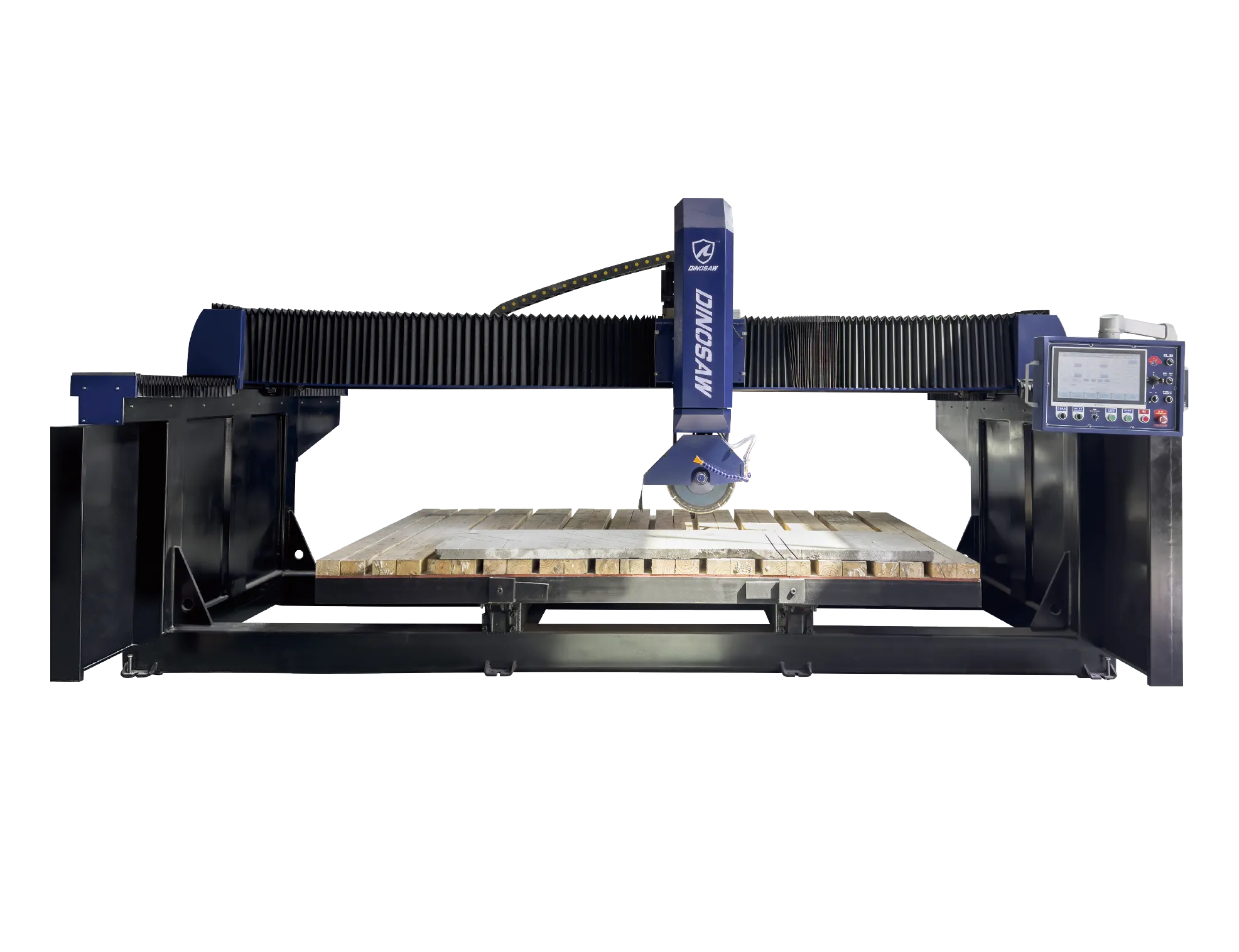
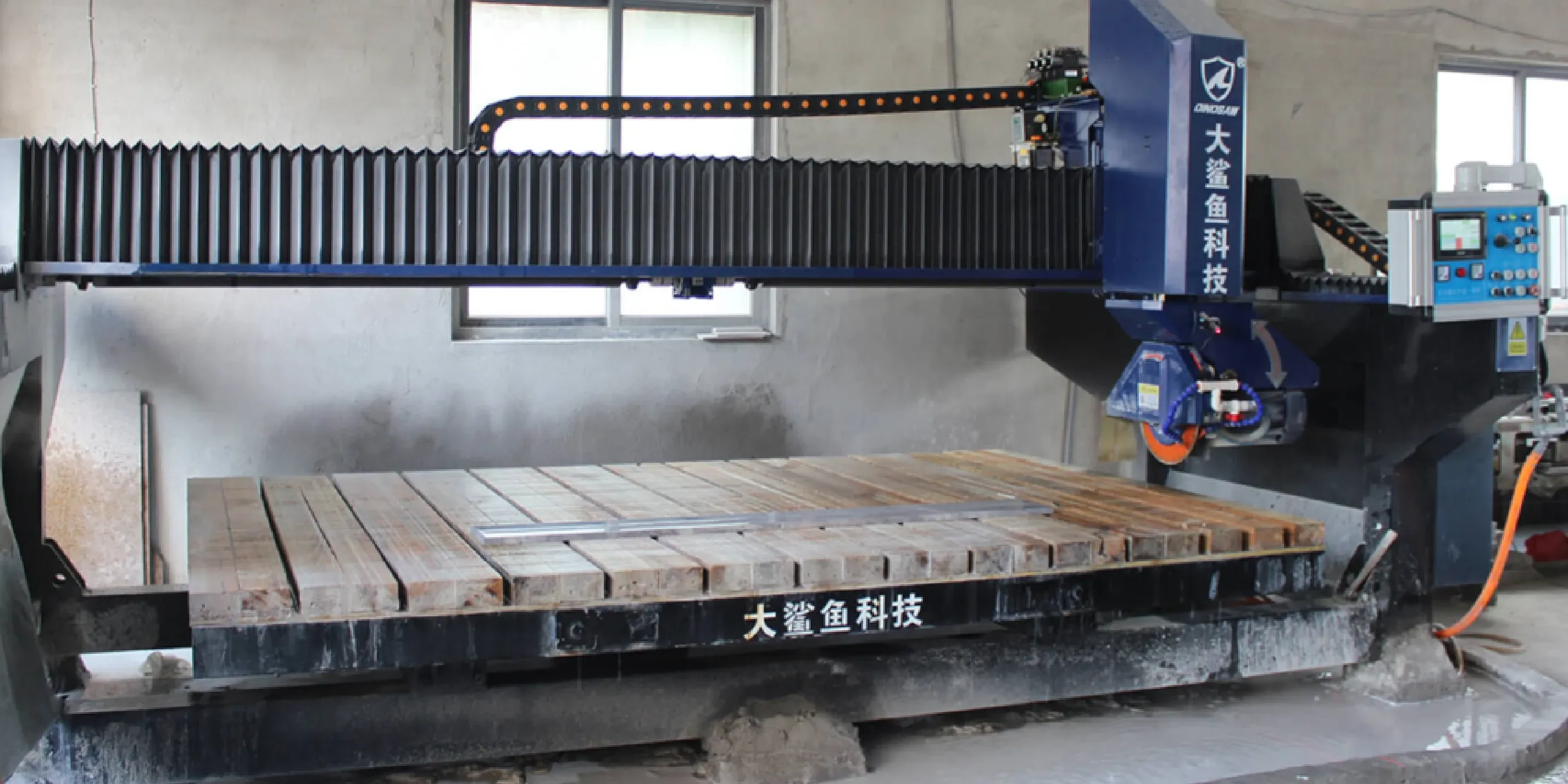
The term "monoblock" refers to the machine's construction from a single, heavy-duty steel frame that integrates the bridge, support columns, and worktable base into one solid unit. This unified structure is the source of its core advantages.
This contrasts sharply with traditional gantry saws, which require separate, permanent concrete foundation walls. The monoblock advantage is threefold: superior rigidity to minimize vibration, elimination of foundation costs, and flexibility for future relocation.this design simplifies the entire ownership lifecycle.
What Are the Core Technical Advantages?
CNC System for Automated Control
The brain of the machine is its Computer Numerical Control (CNC) system. It takes digital design files (e.g., DXF from CAD software) and translates them into precise movements of the cutting head and worktable. By orchestrating all axes simultaneously, the CNC enables the creation of complex geometries—curves, angles, and custom shapes—that are impossible to achieve consistently with manual saws, ensuring high repeatability and reducing operator error.
Servo Motors & Encoders for Precision
Unlike simpler stepper motors, servo motors provide a closed-loop feedback system. Each servo motor is paired with a high-resolution rotary encoder that constantly reports the exact position of the axis back to the CNC controller. If any deviation is detected (e.g., from resistance during a cut), the controller instantly sends a correction signal to the motor. This continuous feedback loop is what allows the YTQJ-600 to achieve its manufacturer-reported ±0.5mm cutting accuracy, ensuring every piece is cut exactly to specification.
Cutting Motions & Options: Travel, Tilt, Rotation
The machine's versatility comes from its axes of movement:
X-Axis: Bridge movement along the length of the worktable.
Y-Axis: Cutting head movement across the bridge.
Z-Axis: Vertical movement of the blade for depth control.
A-Axis (Optional): Tilting of the cutting head, typically from 0° to 45°, for creating mitered edges.
C-Axis (Optional): Rotation of the worktable, enabling cuts at any angle without repositioning the slab.
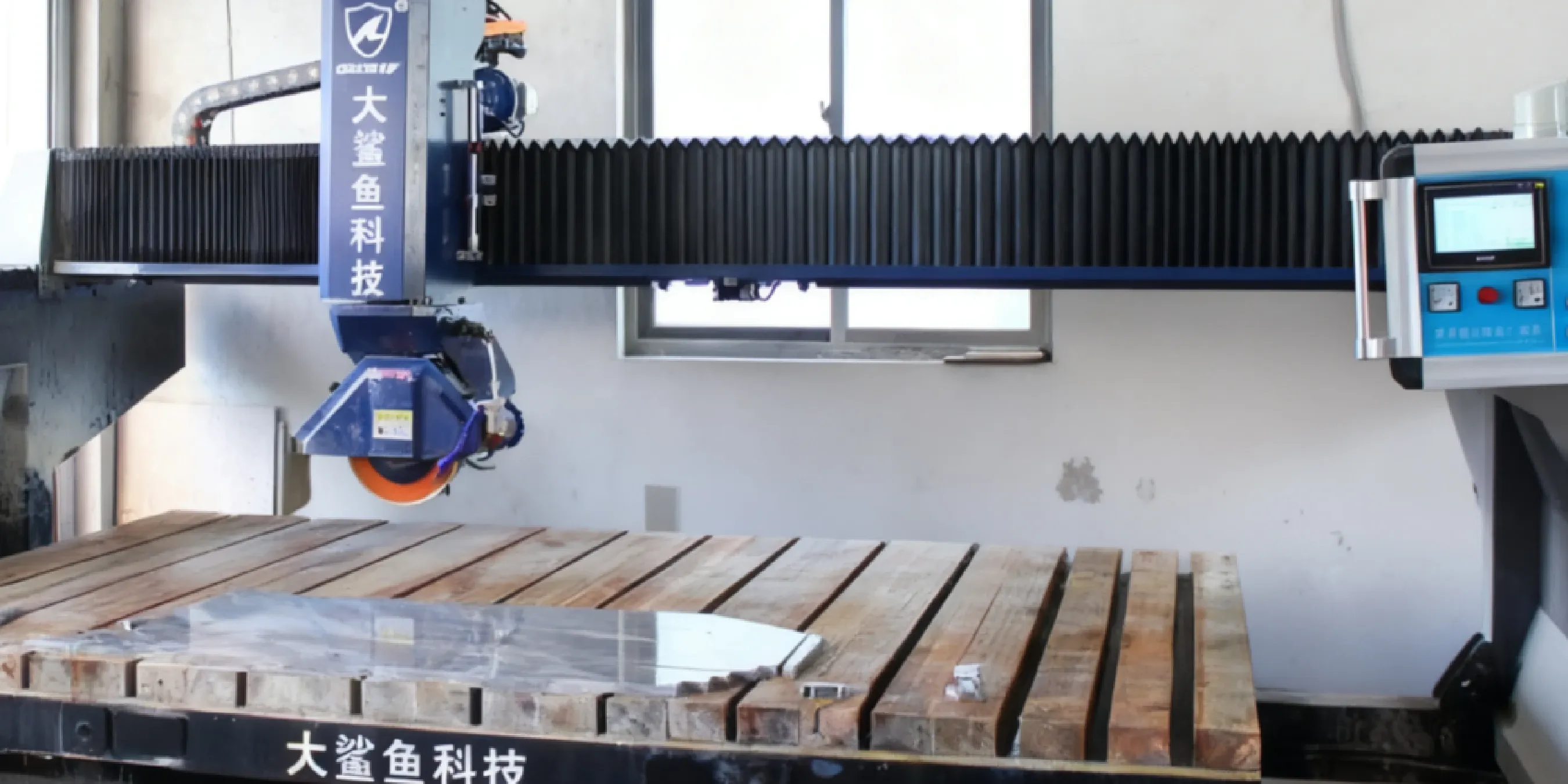
Anatomy of the YTQJ-600: Key Components of this CNC Stone Cutting Machine
Component
Specification
Function
Main Motor
18.5 kW, variable speed
Provides the power to cut through dense materials like granite and quartz. Variable speed allows for optimizing the cut based on material hardness.
Control System
12" touchscreen HMI, multi-language support
The operator's interface for programming jobs, running calibration routines, and monitoring machine status.
Worktable
3200x2000mm, with 0-85° hydraulic tilting
Supports the slab and allows for easy loading via the hydraulic tilt function. Optional C-axis rotation simplifies multi-angle cutting.
Cutting Head
Accommodates 350-600mm blades, 0-45° tilting
Houses the main motor and blade assembly. The optional A-axis tilt is essential for creating precise mitered edges for waterfall countertops.
Guidance System
Linear slide guides
High-precision linear guides on the X, Y, and Z axes ensure smooth, low-friction movement, which is critical for cut quality and accuracy.
System Compatibility & Interfaces
A modern workshop operates on a seamless digital workflow. The YTQJ-600 is designed to integrate easily into this process. Job files can be loaded directly into the control system via USB. The system is compatible with standard CAD file formats, such as DXF and DWG files, allowing designs created in software like AutoCAD or Rhino to be sent directly to the machine for fabrication, minimizing data entry errors and streamlining production from design to final cut.
Frequently Asked Questions (FAQ) on Bridge Saw Technology
What are the main advantages of advanced cutting options?
The main advantage is the versatility to perform a wide range of cuts in a single setup.
Context:A saw with a tilting head and rotating table can perform straight cuts, angled cuts, and miter cuts, as well as complex shapes and curves.
Benefits:This reduces material handling time, increases efficiency, and expands the range of jobs you can complete, from simple countertops to intricate architectural pieces.
Next Step:Evaluate your current and future job mix to determine if the added capability for complex cuts will open up new revenue streams.
How does the CNC control system improve operation?
The CNC system automates the cutting process, ensuring high repeatability, precision, and efficiency.
Context:It allows the machine to execute complex designs directly from a digital file, reducing reliance on manual operator skill.
Benefits:This automation minimizes human error, reduces material waste, and ensures every piece is cut with high precision (e.g., ±0.5mm).
Next Step:Assess your current CAD/CAM workflow to see how seamlessly a CNC machine can be integrated for a "design-to-cut" process.
What does "monoblock design" mean for my workshop?
It means a significantly faster, cheaper, and more flexible installation process for your workshop.
Context:The machine is a single, self-contained unit that does not require the construction of special concrete foundations.
Benefits:This saves weeks of construction time and significant budget. It also provides flexibility, as the machine can be moved in the future if your workshop layout changes.
Next Step:Confirm your concrete floor is solid and level, as this is the only major site requirement for a monoblock machine.
What is the power of the main motor and why is it important for a granite cutting machine?
The YTQJ-600 features a powerful 18.5 kW main motor, which is crucial for high productivity and cut quality.
Context:Hard, dense materials like quartzite and granite require significant power to cut through cleanly and efficiently.
Benefits:A high-power motor prevents the machine from slowing down or stalling, ensuring a smooth cut, preventing damage to the blade, and maintaining high throughput.
Next Step:Compare the motor power (in kW or HP) when evaluating different machines, as this is a key indicator of its cutting capability.
What bridge saw maintenance does the CNC system require?
The CNC system itself is very low maintenance, with upkeep focused mainly on the electrical and mechanical components it controls.
Context:Maintenance typically involves keeping the electrical cabinet clean and dry, checking connections, and ensuring software is updated if applicable.
Benefits:This simplifies the overall maintenance burden, as operators can focus on the mechanical aspects like lubricating guide rails and checking motors.
Next Step:Request a detailed preventive maintenance schedule from the supplier to understand the weekly and monthly tasks required.
Can I upgrade a machine with more features later?
Upgrading a machine with features like a tilting head or rotating table later is generally not feasible or cost-effective.
Context:Adding these capabilities requires a different cutting head, additional servo motors, and a more advanced CNC controller and software.
Benefits:Investing in a machine with the right configuration from the outset is more practical and ensures you have the capability when needed, avoiding significant future downtime and expense.
Next Step:Carefully consider your 2-3 year business plan to decide if the demand for complex cuts justifies the upfront investment in an advanced configuration.
How does the closed-loop system work?
It works as a self-correcting mechanism that ensures superior accuracy by constantly monitoring and adjusting the machine's position.
Context:An encoder on each motor provides constant positional feedback to the CNC controller, which compares the motor's actual position to the target position.
Benefits:If there's a discrepancy, the controller instantly adjusts power to the motor to correct the error, ensuring much higher accuracy than open-loop systems which have no feedback.
Next Step:When comparing machines, always confirm that the axes are driven by servo motors in a closed-loop system, not simpler stepper motors.
What are linear slide guides and why are they important?
They are high-precision rails that ensure the machine's moving parts travel in a perfectly straight line, which is critical for accuracy.
Context:These guides and their bearing blocks constrain the movement of the bridge and cutting head, providing smooth, low-friction travel.
Benefits:This prevents vibration during cutting, which is essential for achieving a flawless, chip-free edge and maintaining the machine's long-term accuracy.
Next Step:During a machine inspection, check that the linear guides are from a reputable brand and ask about the recommended lubrication schedule.




 中文
中文 Italian
 Türkçe
 Português
 Español
 Deutsch
 العربية
 Tiếng Việt
 Français
 Русский






 Oct 20, 20255 MIN READ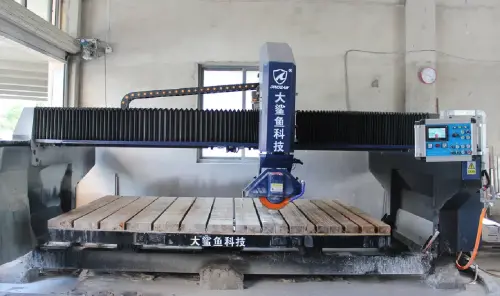
 English