Stone Block Cutter Applications & Case Studies | DINOSAW
lizzy·Nov 21, 2025·8 MIN READ
lizzy·Nov 21, 2025·8 MIN READ
Explore how a dual-blade stone block cutter boosts efficiency for granite, marble, and kerb stones. See real-world case studies and production data.
TL;DR: Key Takeaways
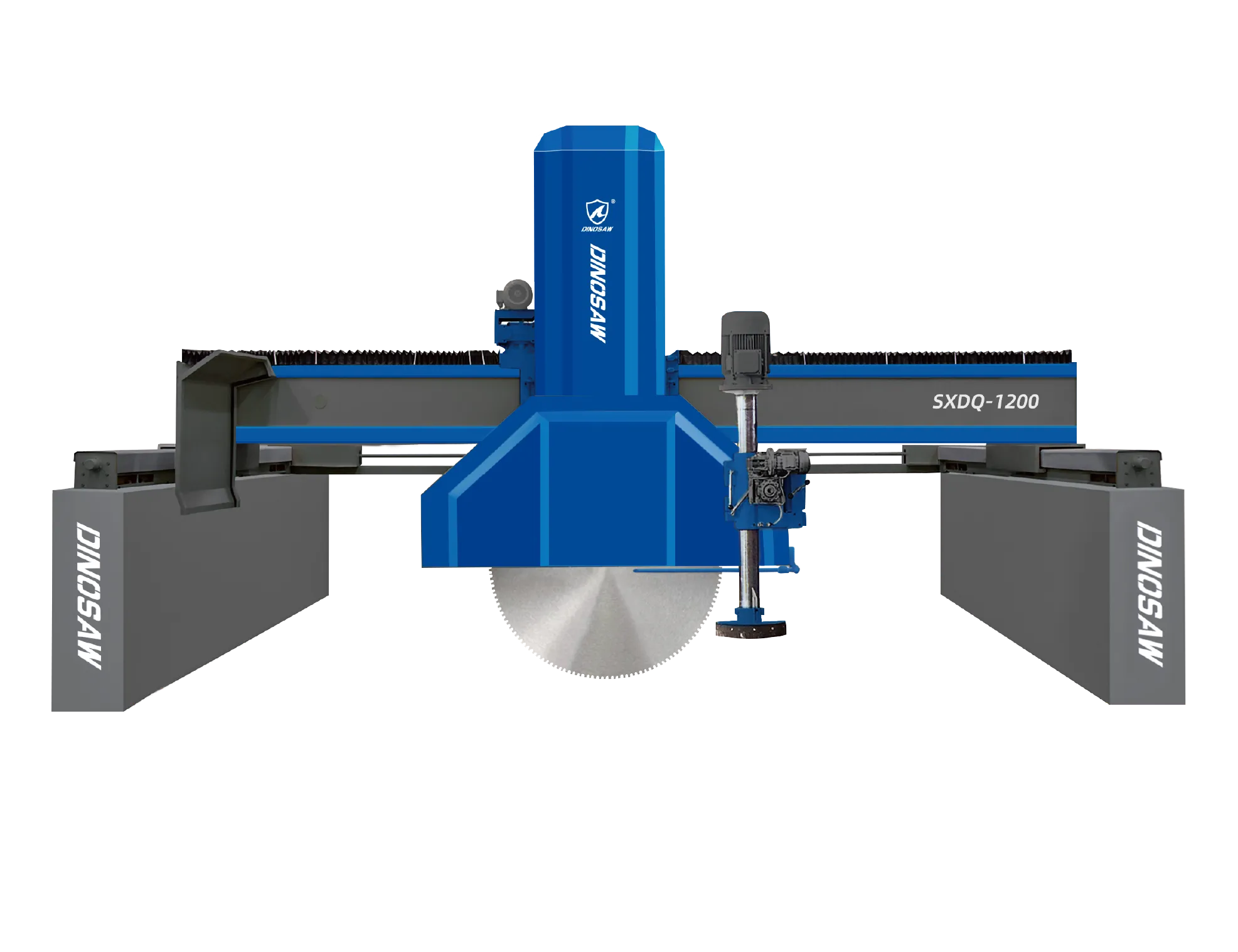
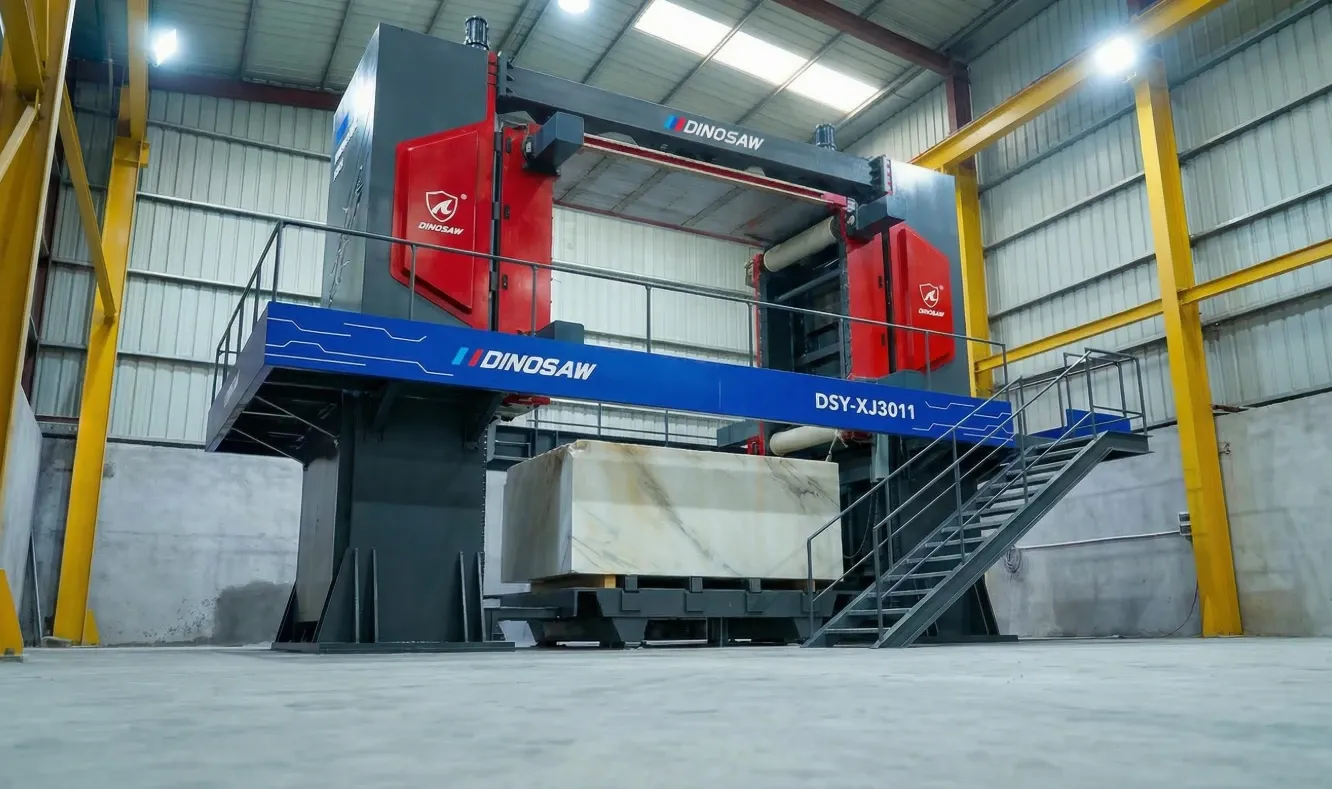
What it does: This Stone Block Cutter with machine automates the process of cutting large stone blocks into multiple slabs of uniform thickness in a single pass, using synchronized vertical and horizontal blades.
Primary Applications: Ideal for high-volume production of granite and marble slabs, limestone kerb stones, sandstone panels, and tombstone/monument bases.
Key Benefit: Dramatically increases throughput and precision by cutting and separating slabs in a single pass (no flipping, no extra bottom cut), reducing labor and material waste compared to single-blade saws.
Disambiguation: This Model Includes a Horizontal Blade
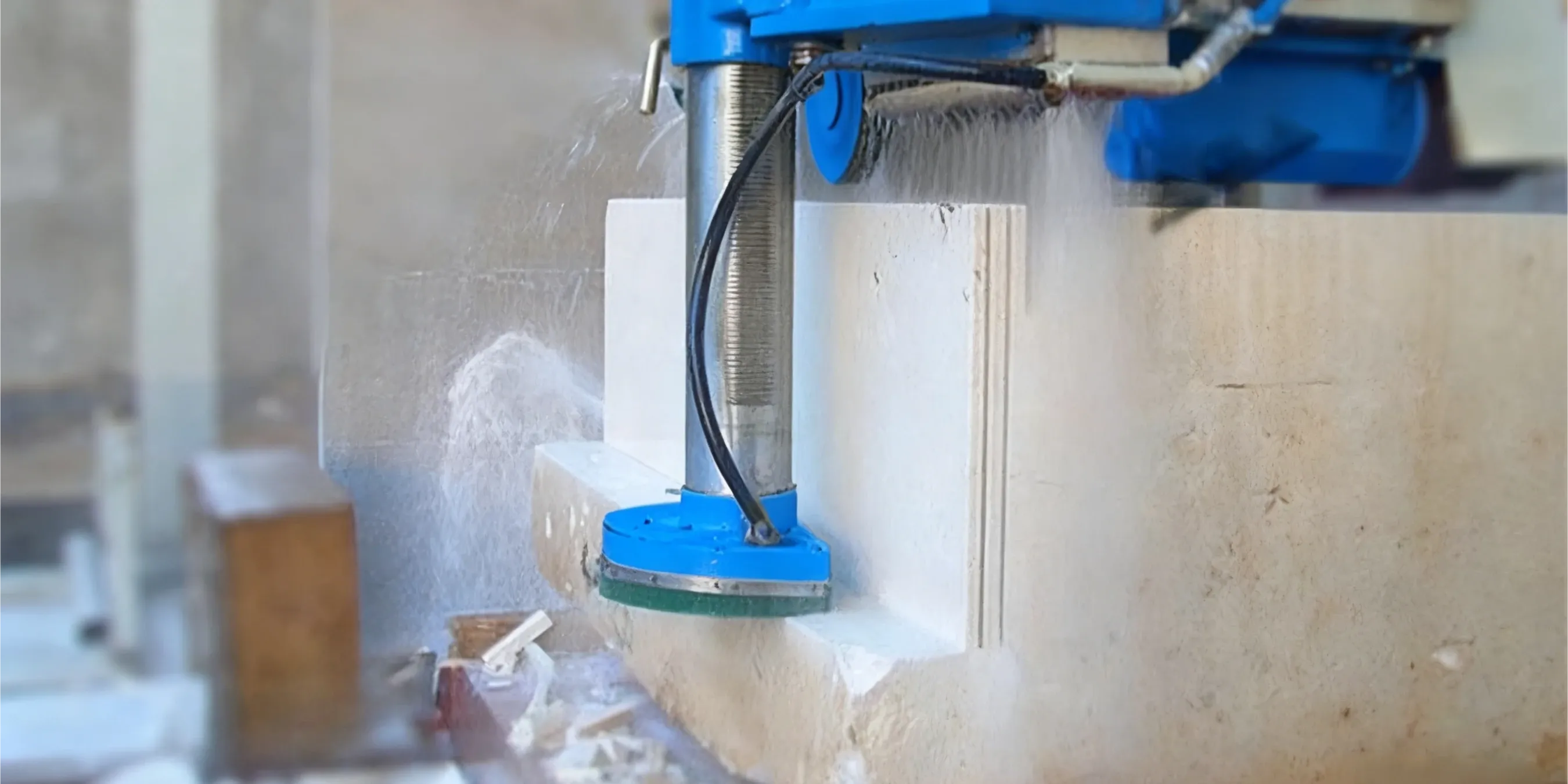
A built-in horizontal blade works in sync with the vertical blade.
It separates the slab in the same pass — no extra bottom cut is needed.
There is no need to flip the heavy block for cross-cutting, making the process safer and faster.
This makes it ideal for producing strips, kerb stones, and slabs.
Your workshop needs to increase slab and dimensional stone output without adding labor. The solution is moving beyond slow, manual splitting processes. This guide shows how our Stone Block Cutter with Horizontal Blade automates cutting for a wide range of materials and applications by cutting and separating in a single pass (no flipping, no extra bottom cut), delivering measurable improvements in efficiency and quality.
What Can a Stone Block Cutter with Horizontal Blade Do For Your Business?
This dual-blade stone cutter is engineered to be a versatile production engine, not just a machine. Its primary function is to transform raw, oversized blocks into high-value, standardized products with speed and precision. By replacing manual, multi-step processes with a single automated operation, it directly addresses key business challenges like production bottlenecks, labor costs, and material waste. Let's break down the specific applications and the tangible value it delivers to your workshop.
From Raw Blocks to Finished Goods: Key Use-Cases
The machine excels in environments that require high-volume, repeatable cutting of rectangular shapes. Here are its primary application clusters:
High-Volume Slab Production: For fabricating granite and marble slabs for countertops, flooring, and wall panels. The machine turns entire blocks into a stack of uniform slabs in one continuous cycle, dramatically increasing inventory turnover.
Kerb Stone & Paver Manufacturing: Ideal for producing standardized limestone or granite kerb stones for municipal and infrastructure projects. Its high speed and repeatability ensure you can meet large order demands on tight deadlines.
Architectural Panels & Cladding: For cutting sandstone and other materials into dimensional panels for building facades. The high dimensional accuracy ensures a perfect fit during installation, reducing on-site adjustments and labor.
Tombstone & Monument Bases: Efficiently produces thick, rectangular bases for monuments. Automating this initial sizing step frees up skilled labor and more versatile CNC machines for the detailed, high-value carving work.
Performance Highlights (Qualitative)
The business value is rooted in qualitative performance improvements:
Consistent Precision: The machine's robust build and PLC control system deliver consistently tight and uniform tolerances, reducing waste and the need for downstream processing.
Increased Throughput: By eliminating the block-flipping time required by single-blade saws, the dual-blade system achieves a significant boost in output for products like granite slabs.
Predictable Output: The automated cutting cycle enables a steady and predictable output of standardized products, such as kerb stones, helping to meet demanding production schedules.
Cycle time per cut depends on material hardness and cutting depth, but the continuous, automated nature of the process ensures maximum uptime during a shift.
Material & Processing Compatibility Guide
The machine's robust construction and powerful motors allow it to handle a wide spectrum of stone types, from hard granites to softer limestones. Success depends on matching the machine's capabilities to the material's properties.
Material
Typical Application
Key Benefit
Granite
Slabs for countertops, flooring, monuments
High power handles hardness; consistent thickness.
Marble
Slabs for architectural panels, tiles, tombstones
Smooth cutting action minimizes fractures.
Limestone
Kerb stones, building blocks, pavers
High-speed, repeatable cuts for standardized products.
Sandstone
Wall panels, cladding, dimensional stone
Precise dimensional control with minimal chipping.
Quartzite
Blocks for further processing into slabs
Handles extreme hardness without blade stalling.
What Are Its Processing Limits? (Can vs. Cannot)
What It Can Do
Cut large blocks up to 3800mm long and 2100mm wide.
Produce slabs with thicknesses from 10mm to 80mm.
Perform automated, repeated rectangular cuts.
What It Cannot Do
Perform curved or profiled cuts (requires a CNC profiler).
Polish or finish surfaces (requires a separate polishing line).
Cut extremely thin veneers below 10mm.
How Does a Stone Block Cutter Machine Work? A Quick Process Overview
The process is designed for maximum automation and minimum operator intervention, a core principle for automating your workflow. It transforms a rough block into a series of identical slabs through a precise, repeatable sequence.
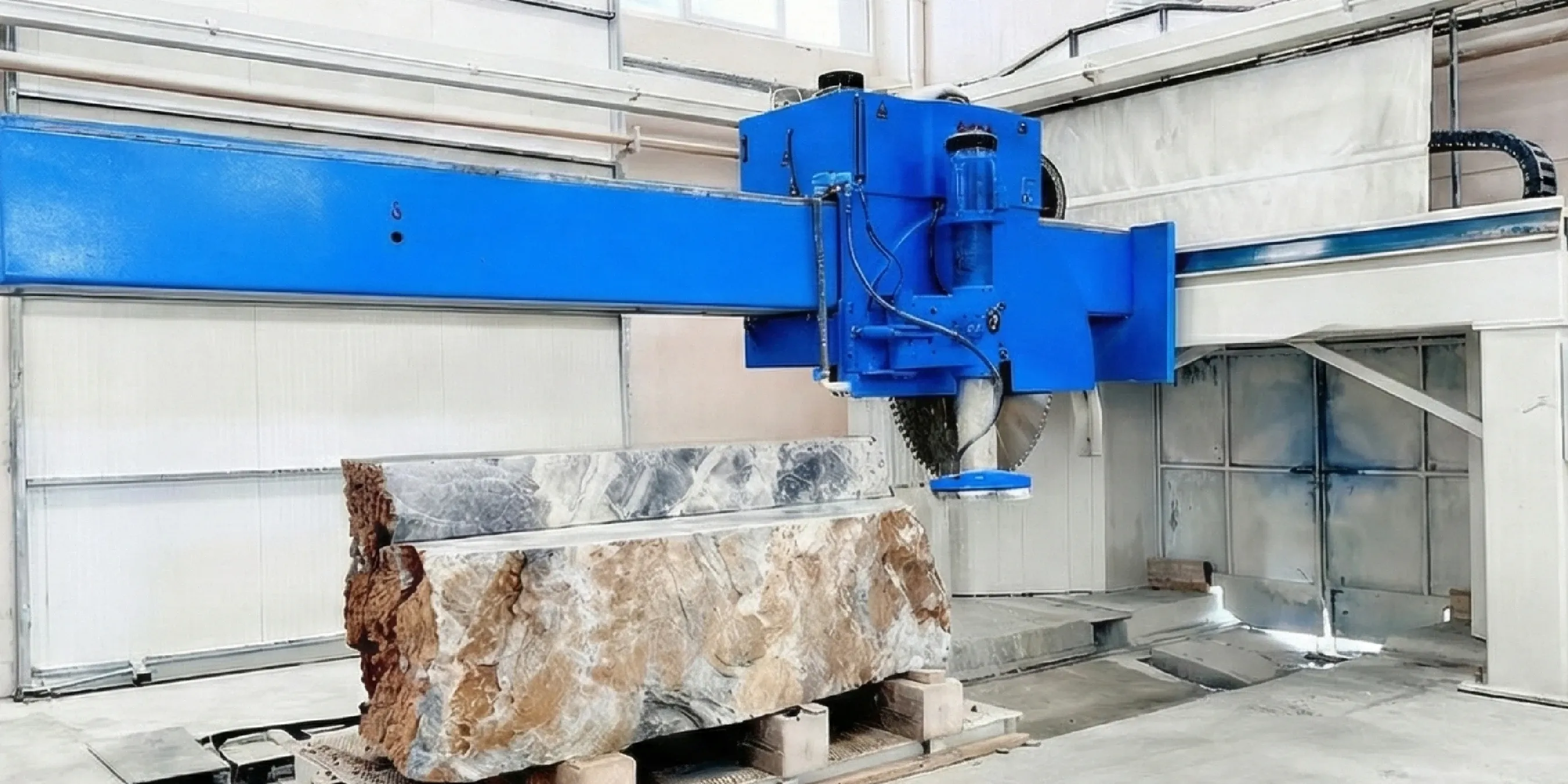
Block Loading: The raw stone block is placed on the machine's trolley.
PLC Programming: The operator inputs the desired slab thickness and number of cuts into the PLC control panel.
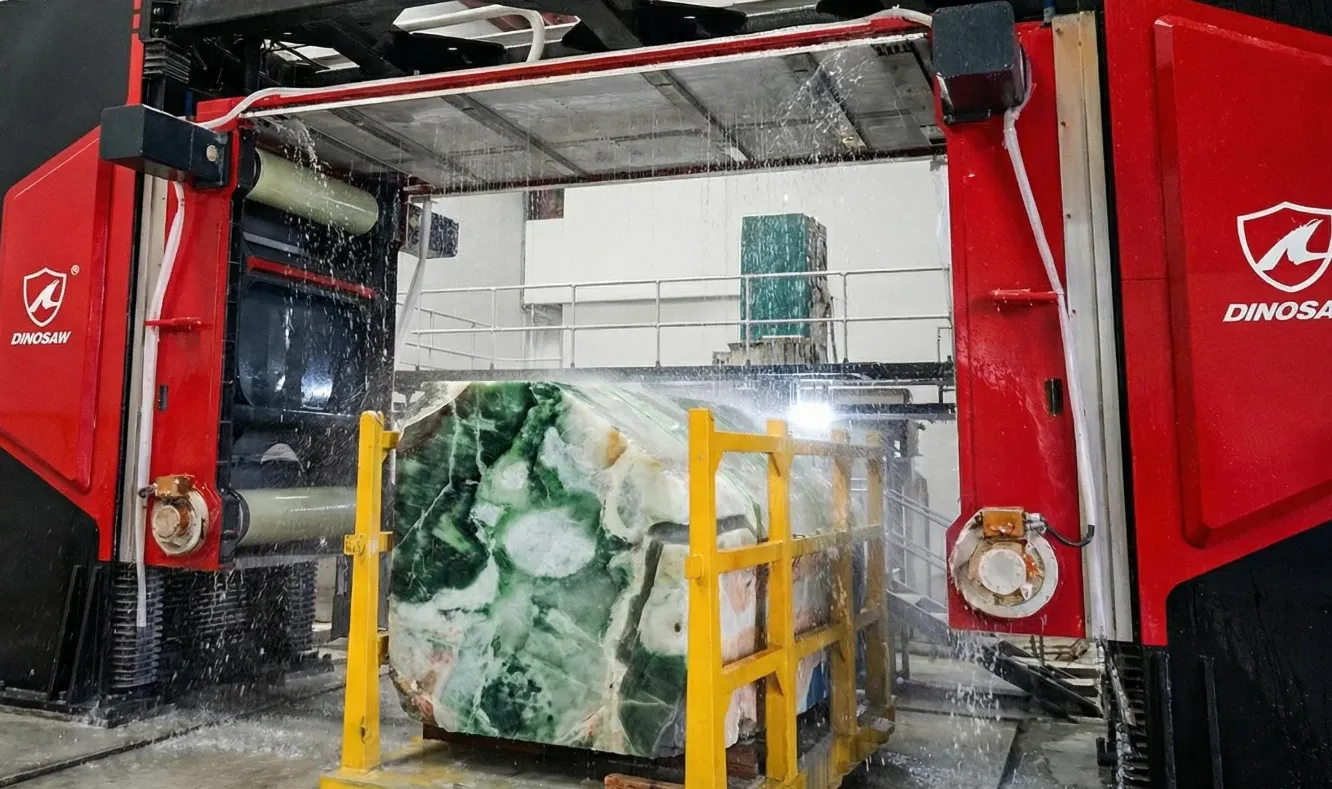
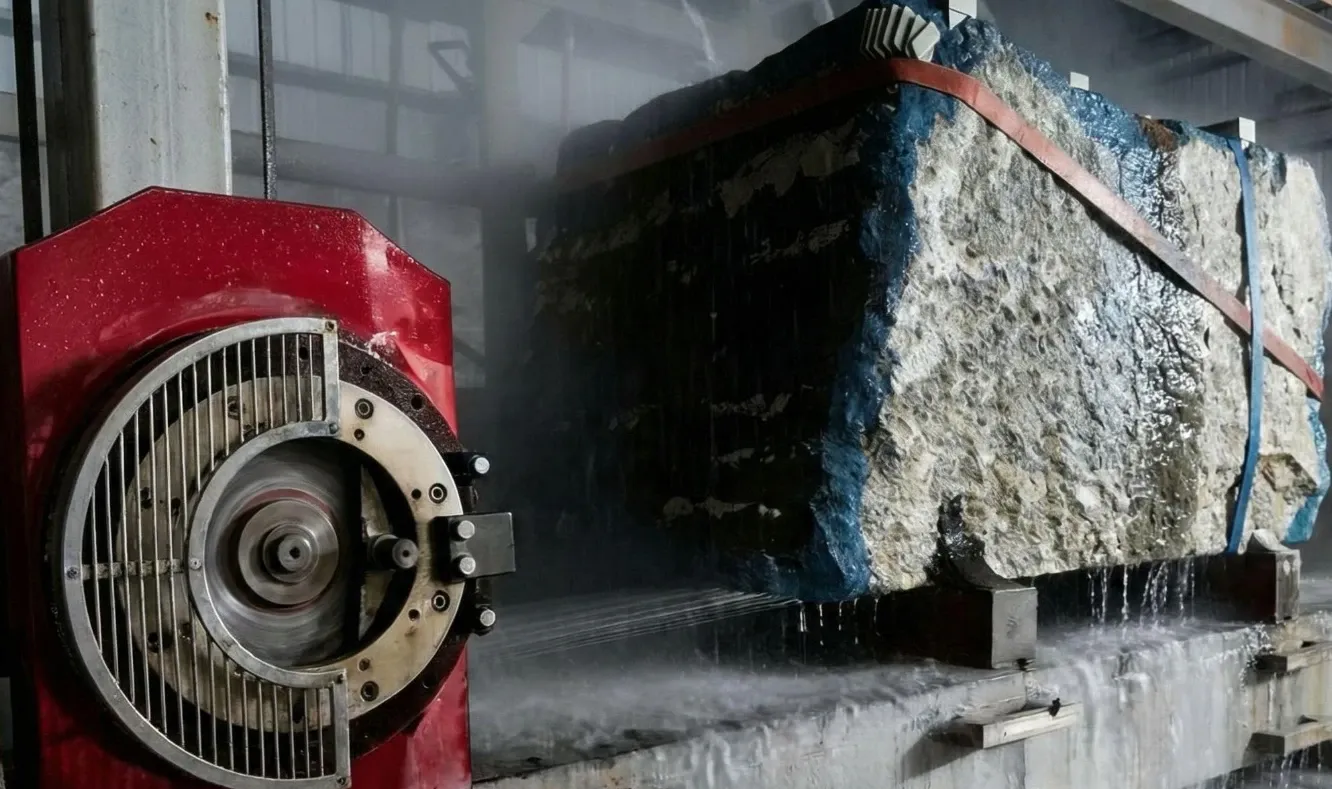
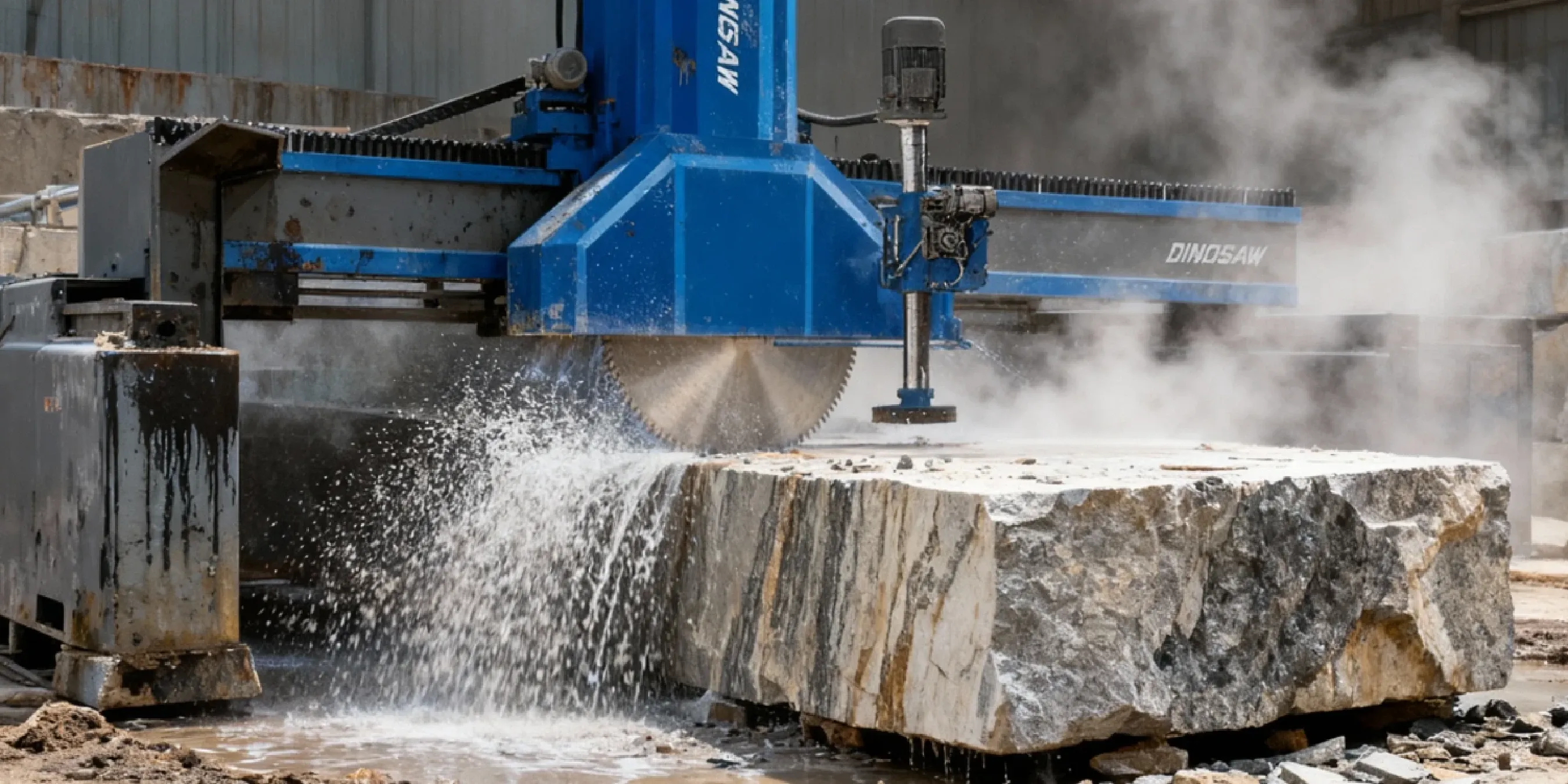
Automated Cutting: The machine begins the cycle. The large vertical blade makes the main cut, immediately followed by the horizontal blade, which separates the slab from the main block.
Slab Removal: The finished slab is removed, and the trolley automatically advances for the next cut.
How Does It Compare to Traditional Methods?
Metric
Dual-Blade Cutter
Manual Splitting
Single-Blade Saw
Efficiency
High
Very Low
Medium
Labor Required
1 operator
Multiple workers
1-2 operators
Safety
High (Automated, enclosed)
Low (High risk of injury)
Medium (Requires block flipping)
Material Waste
Low (high precision)
High (Inconsistent breaks)
Medium
3 Mini-Case Studies from the Field
Case 1: The Monument & Memorial Manufacturer
Problem: Manually sizing heavy granite blocks for tombstones was a slow, hazardous process that created a production bottleneck and tied up skilled labor.
Solution: Replaced two single-blade saws with one dual-blade cutter to automate the initial block sizing, eliminating the need to flip heavy blocks.
Result: Daily output increased significantly, material handling injuries were eliminated, and artisans were freed for high-value carving work.
Case 2: The Kerb Stone Supplier
Problem: Meeting high-volume municipal orders for limestone kerb stones required a significant boost in production speed without sacrificing dimensional accuracy.
Solution: Automated the production line with a dual-blade cutter, leveraging its high-speed, repeatable cutting capabilities for standardized products.
Result: Achieved a clear efficiency boost, delivering a steady, predictable output with consistent tolerances that met strict contract specifications.
Case 3: The Architectural Panel Fabricator
Problem: An order for 800+ identical sandstone panels for a building facade required near-perfect consistency to avoid costly on-site rework and project delays.
Solution: The project was assigned to the dual-blade cutter to ensure every panel was cut to the exact same specifications from the start.
Result: Achieved a minimal rework rate. The machine's consistent cutting performance ensured all panels maintained consistent tolerances, keeping the project on schedule and on budget.
Application-Driven Blade & Segment Selection
Choosing the right blade and diamond segments is critical for optimizing blade performance and achieving clean cuts. The selection depends entirely on the stone's hardness and abrasiveness.
For Hard Stones (Granite, Quartzite): Use segments with a softer metal bond. The bond wears away faster, exposing new diamond particles to effectively cut the hard material.
For Soft/Abrasive Stones (Marble, Sandstone): Use segments with a harder metal bond. This prevents the diamonds from being stripped away too quickly by the abrasive material, prolonging blade life.
Optimizing for Edge Quality & Tolerance
Achieving a perfect edge finish and maintaining tight tolerances requires fine-tuning the cutting parameters. Here are key tips:
Manage Feed Rate: Pushing the machine too fast can cause blade deflection and chipping. Start with the recommended parameters and adjust based on the cut quality.
Ensure Ample Cooling: Insufficient water flow causes overheating, which can warp the blade and damage segments, leading to poor cuts. Always check that water is coating both sides of the blade evenly.
Regularly Check Blade Tension: A loose blade will vibrate and produce a rough, inaccurate cut. Follow the maintenance schedule for checking and tensioning blades.
Note: These are suggested starting ranges. Always conduct a test cut and adjust for optimal performance. Final parameters are dependent on the specific mineral composition of your stone and the blade segments used.
Material
Feed Rate
Blade Speed
Cooling Flow
Expected Tolerance
Granite
Low to Medium
Match to material hardness
Continuous high flow
Tight and consistent
Marble
Medium to High
Adjust for smooth finish
Continuous, ample flow
High precision
Limestone
High
Optimized for speed
System capacity (20 m³/h)
Consistent
Sandstone
Medium
Adjust to minimize chipping
Ensure full blade wetting
Consistent
Quartzite
Low
High torque configuration
Continuous high flow
Tight and consistent
Integrating the Stone Block Cutter with Horizontal Blade into Your Production Line
The dual-blade block cutter is the first step in a larger production workflow. Slabs produced by the machine are raw and require further processing to become finished products. Effective integration with downstream equipment is key to maximizing overall factory throughput.
Sizing and Custom Cuts
After the block is cut into slabs, the slabs are typically moved to a 3/4/5 axis CNC Bridge Saw. This machine performs the precise secondary cuts needed for countertops, tiles, or custom architectural components.
Surface Finishing
Once sized, the slabs proceed to a finishing stage. For achieving a perfect surface finish, slabs are fed into an automated polishing line, which grinds and polishes the surface to the desired level of gloss.
Measuring Success: Qualitative Pilot Metrics
When evaluating the impact of a new block cutter, focus on these qualitative checks to validate its readiness for full-scale production:
Quality of Cut: Are the cut surfaces and edges consistently clean and within acceptable visual standards? (Document with photos).
Operational Readiness: Are operators fully trained and following standard operating procedures (SOPs)? Is a preventive maintenance schedule in place?
Safety Compliance: Is the team consistently following all safety protocols, including Lockout/Tagout (LOTO) for maintenance?
Process Continuity: Does the machine operate smoothly without frequent unplanned stops or manual interventions?
Proper planning for installation, safety, and environmental controls is essential for a smooth commissioning and long-term operational success.
Site Prerequisites: Ensure a solid, level concrete foundation and adequate space for loading/unloading blocks and slabs.
Power & Water Supply: Verify that the electrical supply matches the machine's requirements (e.g., 75kW main motor for a large model) and that a sufficient water supply is available for blade cooling.
Dust & Water Management: Effective dust suppression is not just a best practice; it is a critical safety requirement. According to OSHA's standard 1926.1153, employers must use engineering controls like wet cutting to limit worker exposure to respirable crystalline silica. The U.S. National Institute for Occupational Safety and Health (NIOSH) also strongly recommends water spray systems to control dust. Implement a closed-loop water recycling and slurry management system to conserve water and manage waste responsibly.
Operator Training: While automated, operators must be trained on PLC operation, safety procedures, and basic maintenance. We provide comprehensive training to ensure your team is fully prepared.
Frequently Asked Questions (FAQ)
What is a horizontal blade on a stone cutter used for?
Primarily, it automates the slab separation process, boosting safety and speed.
Context: It works in tandem with the vertical blade during the cutting cycle. The vertical blade cuts down, and the horizontal blade immediately cuts across the bottom to separate the slab.
Benefits: This eliminates the need for manual splitting or flipping heavy blocks, which prevents a major production bottleneck, reduces labor, and significantly improves operator safety.
Can this machine cut hard materials like quartzite blocks?
Yes, it is specifically engineered for high-hardness materials.
Context: When processing extremely hard stones like quartzite or dense granite, where other machines might stall or vibrate excessively.
Benefits: The machine's rigid bridge structure and high-power motor (e.g., 75kW) provide the necessary torque and stability to cut through these materials smoothly and efficiently.
Next Step: If you work with hard materials, contact our experts to discuss the right configuration for your needs.
For producing standard slabs, is a dual-blade cutter more efficient than a bridge saw?
Yes, for high-volume, repetitive slab cutting, it is significantly more efficient.
Context: A bridge saw is a versatile tool for making custom, angled, or secondary cuts on a single slab. A dual-blade block cutter is a specialized production machine for turning entire blocks into multiple slabs.
Benefits: The block cutter operates in a continuous, automated cycle, processing the entire block with minimal downtime. A bridge saw requires more setup and handling for each individual cut, making it slower for bulk production.
Next Step: Evaluate if your workflow is primarily bulk production or custom jobs to determine the right machine. Learn more about the specialized block cutter here.
How much can this machine increase daily throughput for kerb stone production?
Workshops typically see a significant efficiency increase.
Context: In the production of standardized items like kerb stones, speed and repeatability are key. This machine is designed for continuous, automated cutting.
Benefits: By eliminating the need to stop and flip the block between cuts, the machine maximizes uptime and can produce a significantly higher volume per shift compared to traditional methods.
Next Step: To calculate the potential ROI for your specific output needs,request a consultation with our production experts.
What cutting tolerance can be expected when processing large granite blocks?
You can consistently achieve a high degree of precision, typically within ±2mm.
Context: For applications like architectural panels or high-end countertops, dimensional accuracy is critical to ensure a perfect fit and finish.
Benefits: This level of accuracy minimizes material waste from out-of-spec cuts and reduces the need for secondary grinding or calibration, saving both labor time and material costs.
Next Step: Learn more about the machine's technical specifications on the product page.
Can I cut slabs of different thicknesses in the same batch?
Yes, the machine's control system allows for programmable cutting sequences.
Context: When a single block needs to be processed into products with varying specifications, such as a mix of 2cm and 3cm slabs for a project.
Benefits: You can program a sequence (e.g., five 20mm cuts followed by three 30mm cuts) into the PLC. The machine will execute the entire batch automatically without needing operator intervention between thickness changes, maximizing efficiency.




 中文
中文 Italian
 Türkçe
 Português
 Español
 Deutsch
 العربية
 Tiếng Việt
 Français
 Русский






 Nov 21, 20258 MIN READ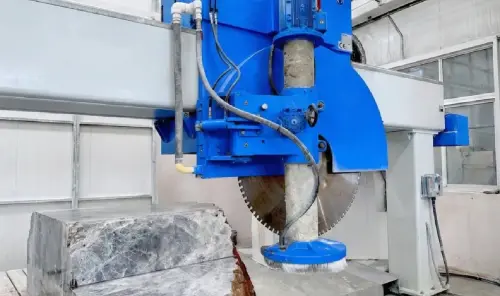

 English