Executive Guide to Investing in a Horizontal Blade Stone Block Cutter
lizzy·Nov 25, 2025·4 MIN READ
lizzy·Nov 25, 2025·4 MIN READ
This guide covers the investment points, a 90-day qualitative pilot plan, and a decision matrix for adopting a dual-blade stone cutter for granite slab and kerb stone production.
TL;DR: The Business Case
Core Value Proposition: Transitions your workshop from a slow, labor-intensive, stop-and-go process to a continuous, automated, and high-throughput production line.
Primary Use Case: Ideal for factories focused on high-volume, standardized products like slabs, panels, and kerb stones, where it removes the primary production bottleneck.
Decision Framework: This Stone Block Cutter with Horizontal Blade Machine is a strategic investment in efficiency and scalability. It's chosen when maximizing output and reducing labor dependency outweighs the need for universal flexibility.
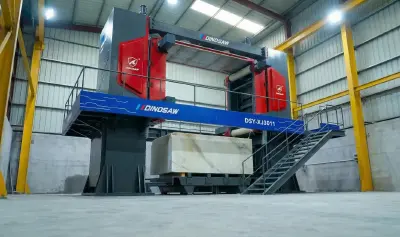
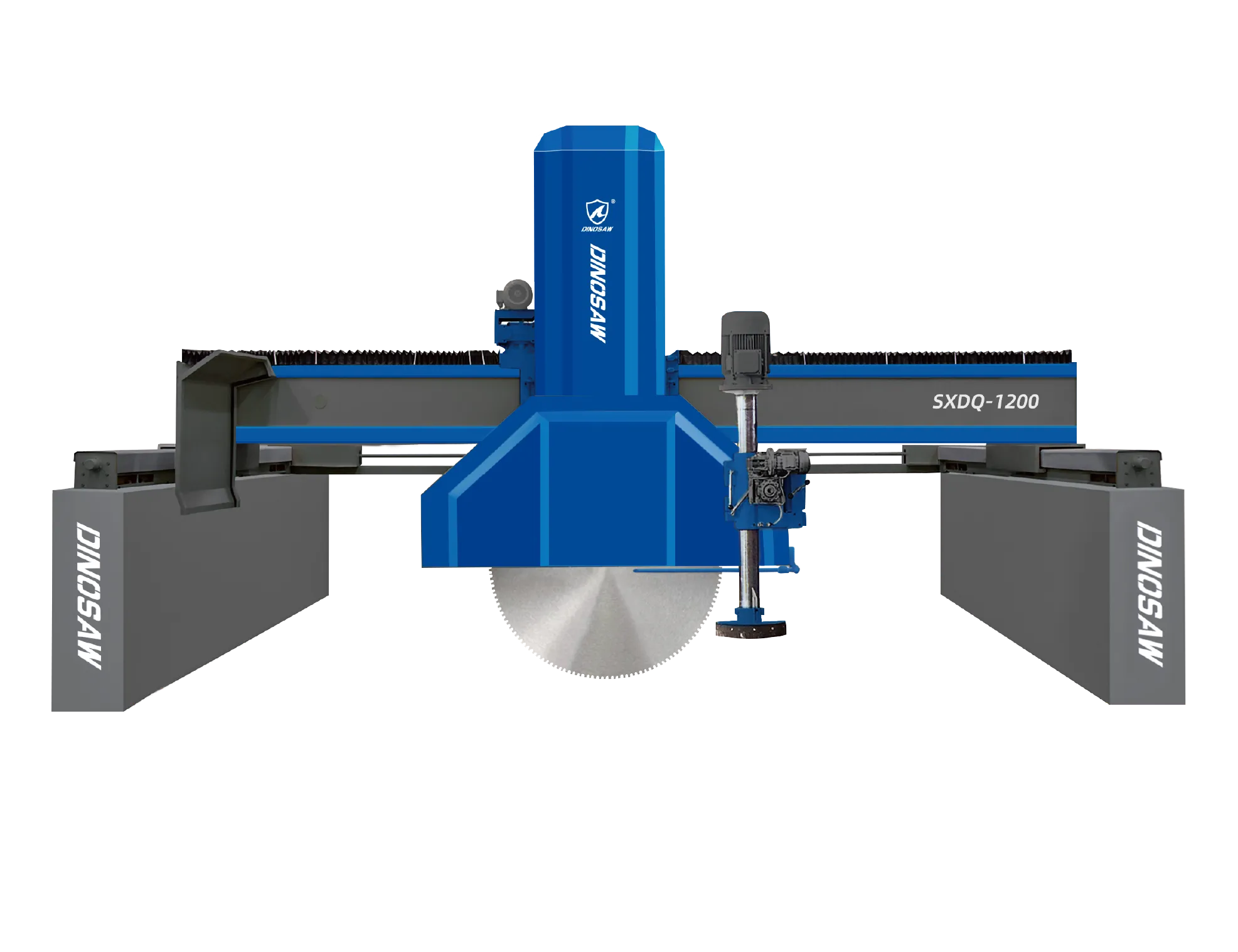
This document synthesizes the strategic, technical, and operational case for investing in a horizontal blade stone block cutter. The decision hinges on a clear understanding of your primary production goal. For workshops focused on high-volume, standardized products, manual or semi-automated methods create a significant bottleneck, limiting growth and inflating labor costs. The dual-blade cutter directly addresses this by automating the most time-consuming step: slabbing raw blocks. By integrating this machine at the start of your production line (Block Cutter → CNC Bridge Saw → Polishing Line), you transform the entire workflow from a stop-and-go process into a continuous, efficient flow. Success is measured by clear qualitative improvements: a significant increase in throughput, a much lower rework rate, and a notable drop in labor hours per unit produced.
Focus on correct installation, safety validation, and intensive operator training. Goal is to ensure the team can operate the machine safely and understands its basic functions and maintenance requirements.
Phase 2: Baseline Operations (Weeks 3–6)
Begin running the machine on non-critical production batches. The goal is to establish stable operating parameters for different materials and to integrate the machine into the daily workflow.
Phase 3: Stability & Integration (Weeks 7–10)
Operate the machine under normal production demands. Focus on observing workflow continuity, identifying any downstream bottlenecks, and ensuring preventive maintenance schedules are being followed.
Phase 4: Stakeholder Review (Weeks 11–12)
Conduct a final review based on the Go/No-Go checklist. Present qualitative evidence (photos of cut quality, operator feedback, maintenance logs) to stakeholders for final sign-off.
Go/No-Go Checklist (Qualitative)
Safety & Compliance: Have all safety protocols been successfully implemented and consistently followed by the team?
Operational Readiness: Can operators run the machine independently without frequent supervision or unplanned downtime?
Quality Evidence: Does the machine consistently produce slabs and blocks that meet our quality standards for finish and dimensional accuracy?
Integration & Scheduling: Does the output of the block cutter feed smoothly into the next stage of production (e.g., bridge saw) without creating new bottlenecks?
Stakeholder Sign-Off: Do the production manager, safety officer, and lead operator all agree that the machine is a valuable and effective addition to the workflow?
Your Next Step: A Complete Resource Hub
Making a major capital investment requires thorough research. Use our complete blog series to guide your decision.
Plan for uptime: Review the Maintenance & Troubleshooting Guide
Executive FAQ: Key Investment Questions
What’s the key difference between a dual-blade block cutter and a single-blade saw?
The core difference is continuous throughput versus a stop-and-go process. The dual-blade cutter eliminates a major step, unlocking a higher level of efficiency.
Context: A single-blade saw requires the operator to cut, stop, flip the entire heavy block, and then cut again to separate a slab. This is slow, labor-intensive, and hazardous.
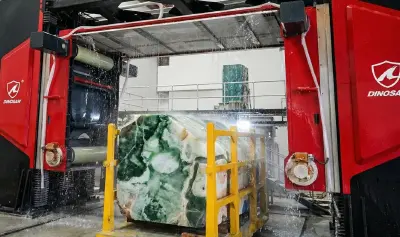
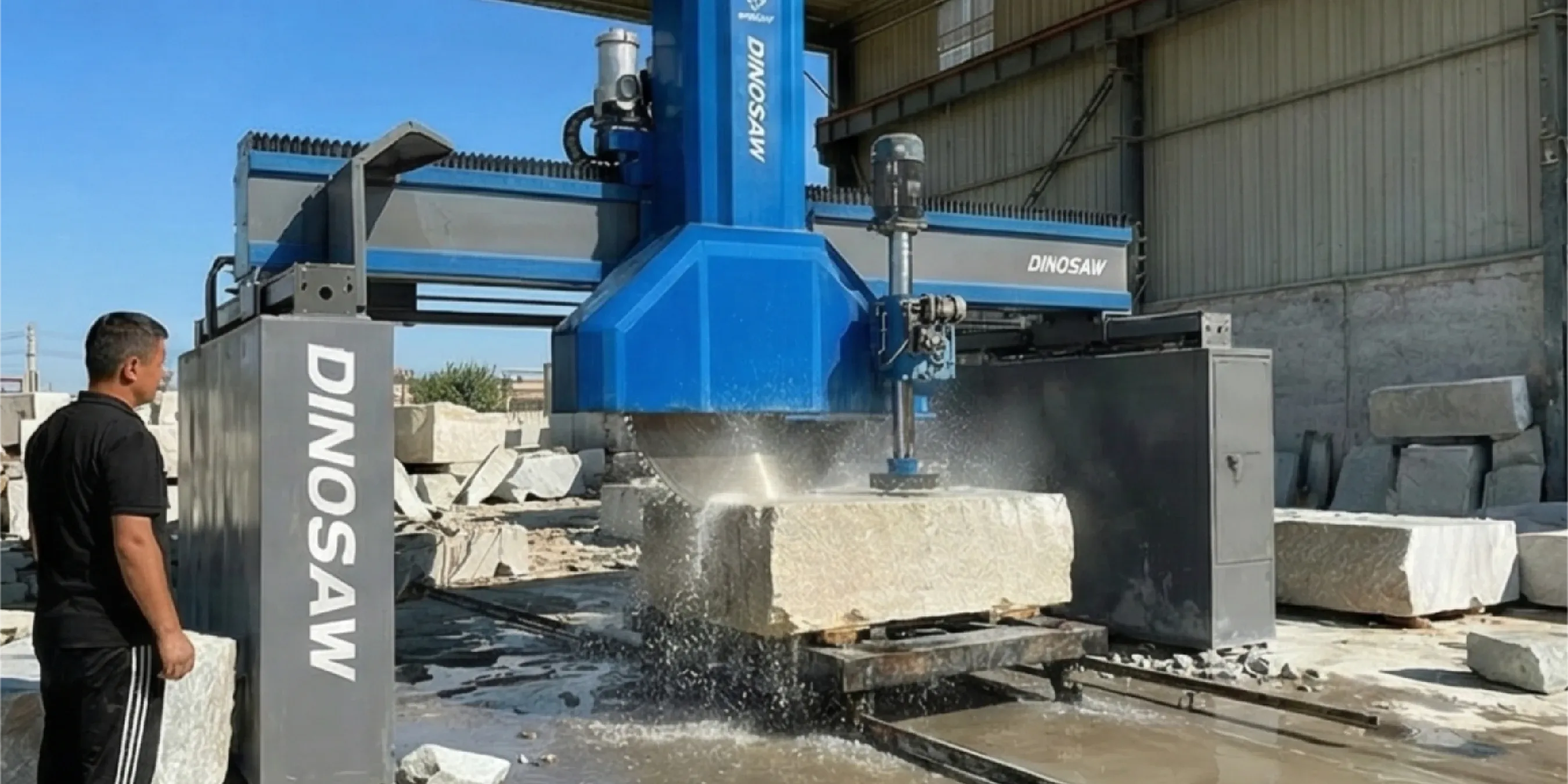
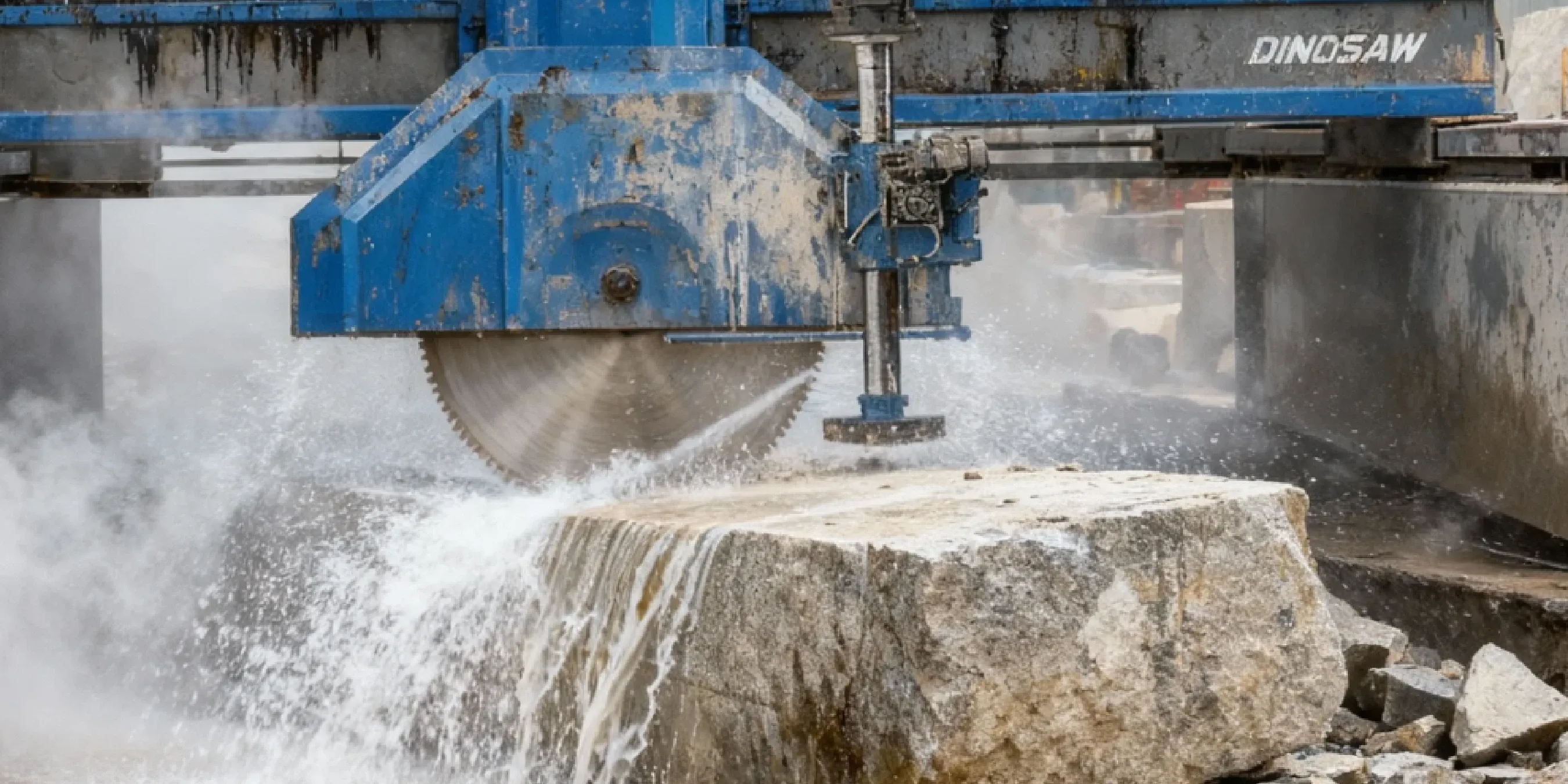
Procedure: The dual-blade machine automates this. Its synchronized vertical and horizontal blades cut and separate the slab in a single, continuous pass. The block never needs to be flipped.
Next Step: Review the comparison table in the Buyer's Guide to see a direct feature-by-feature breakdown.
Can the same machine handle both granite and marble consistently?
Yes, the machine's robust design and adjustable parameters make it versatile enough for both, but it requires using the correct blades and settings for each material.
Context: Granite is extremely hard and requires high motor power and a blade with a softer bond to expose new diamonds. Marble is softer but more fragile, requiring a smoother cutting action to prevent fractures.
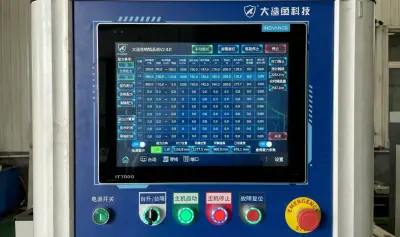
Procedure: The high-power motor and rigid frame provide the stability for granite. For marble, the operator adjusts the feed rate and blade speed via the PLC to ensure a less aggressive, smoother cut. Blade segments must be swapped for optimal performance.
Next Step: Consult the Technical Principles guide for details on material-specific parameter settings.
How does water recycling impact operating costs and compliance?
It has a significant positive impact on both. A closed-loop system dramatically reduces water bills and is often essential for meeting environmental regulations.
Context: A block cutter can use a large volume of water (e.g., 20 m³/h) for cooling and dust suppression. Discharging this slurry-filled water is often regulated and costly.
Procedure: A recycling system filters the stone particles (slurry) out of the water, allowing the clean water to be pumped back to the machine. The collected slurry can be disposed of as a semi-solid waste, which is often easier and cheaper to manage.
Next Step: Before purchasing, investigate local environmental regulations for water discharge and slurry disposal. Request information on integrating a water recycling system with the machine.
What are the footprint and power requirements for a large dual-blade block cutter?
Plan for a large footprint and three-phase power; exact specs depend on configuration.
Context: Space, foundation, and electrical capacity determine installation viability.
Procedure: Verify site dimensions, prepare a level reinforced concrete foundation, confirm three-phase power and adequate water supply for wet cutting.
Next Step: Request a site readiness checklist and a pre-install survey from the vendor.
Can the block cutter share production data with our ERP/MES?
Yes—modern PLCs support standard industrial protocols for data exchange.
Context: Cycle status, alarms, and job parameters improve scheduling and OEE tracking.
Procedure: Enable OPC UA/Modbus TCP on the PLC, map tags for cycle times and statuses, test connectivity with your MES sandbox.
Next Step: Ask for a data points list and integration guide before purchase.
What does operator training and onboarding involve?
A structured program covers safety, PLC/HMI operation, basic maintenance, and first-week supervised runs.
Context: Consistency and safety depend on formal training, not informal shadowing.
Procedure: Conduct classroom safety (CE/OSHA), hands-on PLC presets, blade change practice, daily/weekly checklists; run pilot batches with a trainer present.
Next Step: Schedule a training calendar and keep signed attendance and competency records.
How is this block cutter different from other types without a horizontal blade?
It combines the vertical cut and horizontal separation into one automated step, eliminating the need to flip the block or perform a second cut.
Context: Standard block saws or bridge saws make the vertical cut, but the slab remains attached at the bottom. This requires a time-consuming and often hazardous manual process to flip the heavy block for a separating cut, creating a major production bottleneck.
Procedure: This machine uses synchronized blades. The large vertical blade cuts down, and the smaller horizontal blade immediately follows, cutting along the bottom to cleanly separate the slab in a single, continuous pass. This is ideal for producing strips, kerb stones, and slabs efficiently.
Next Step: Review the technical diagram in the Core Technology guide to visualize how the synchronized blades create a continuous workflow.





 中文
中文 Italian
 Türkçe
 Português
 Español
 Deutsch
 العربية
 Tiếng Việt
 Français
 Русский






 Nov 25, 20254 MIN READ
 Executive Summary: The Strategic Advantage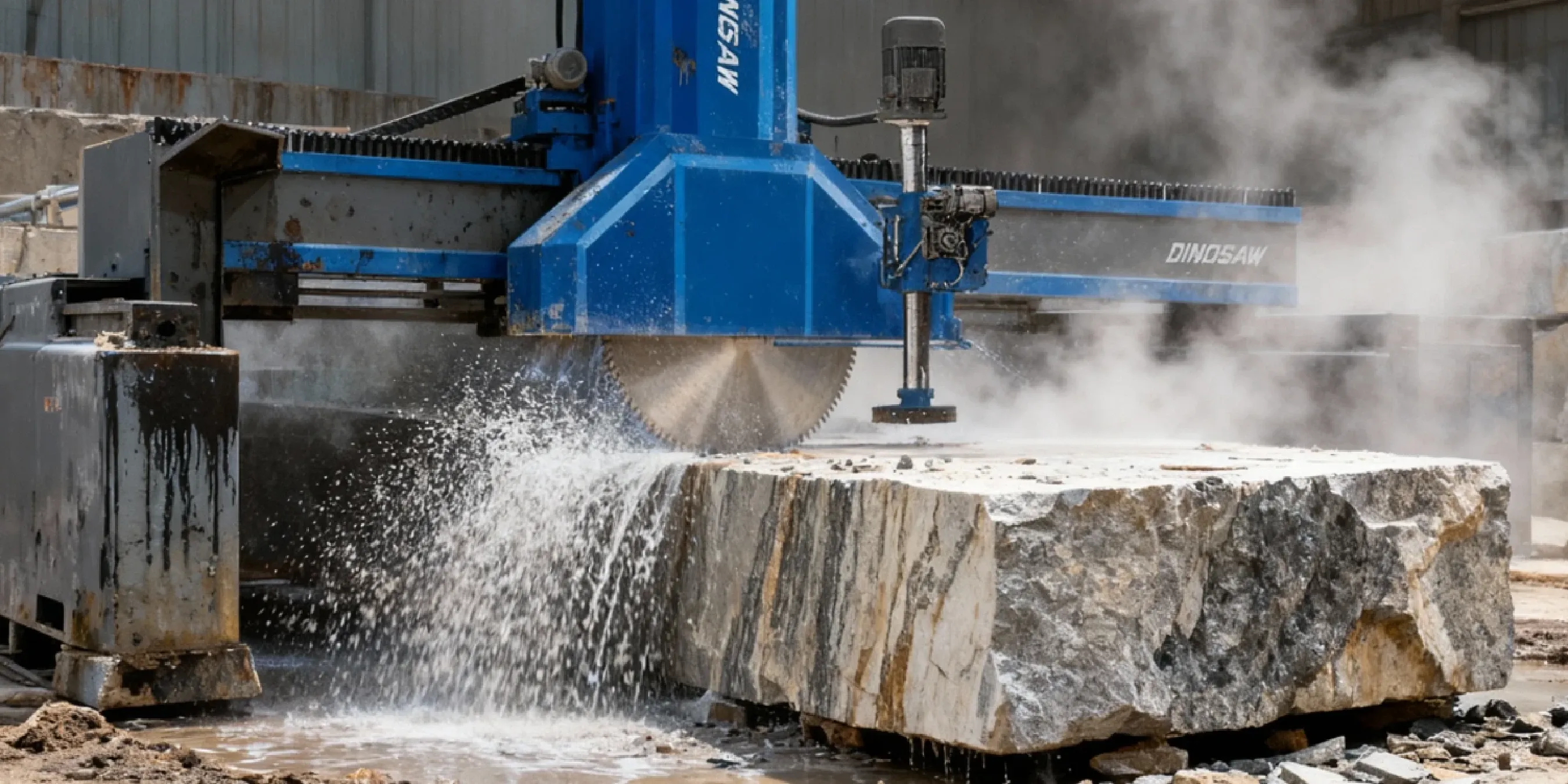
 English